Why Guangzhou Became a Fragrance and Cosmetics Manufacturing Hub
Guangzhou did not become a fragrance manufacturing centre because of one natural advantage. It became one because glass, closures, pumps, cartons, label printing, tooling and filling all ended up within a short drive of each other, and because a large cosmetics industry next door kept demand for those services steady. For a buyer, the cluster means faster component iteration and more choices; it does not mean every supplier is equally capable.
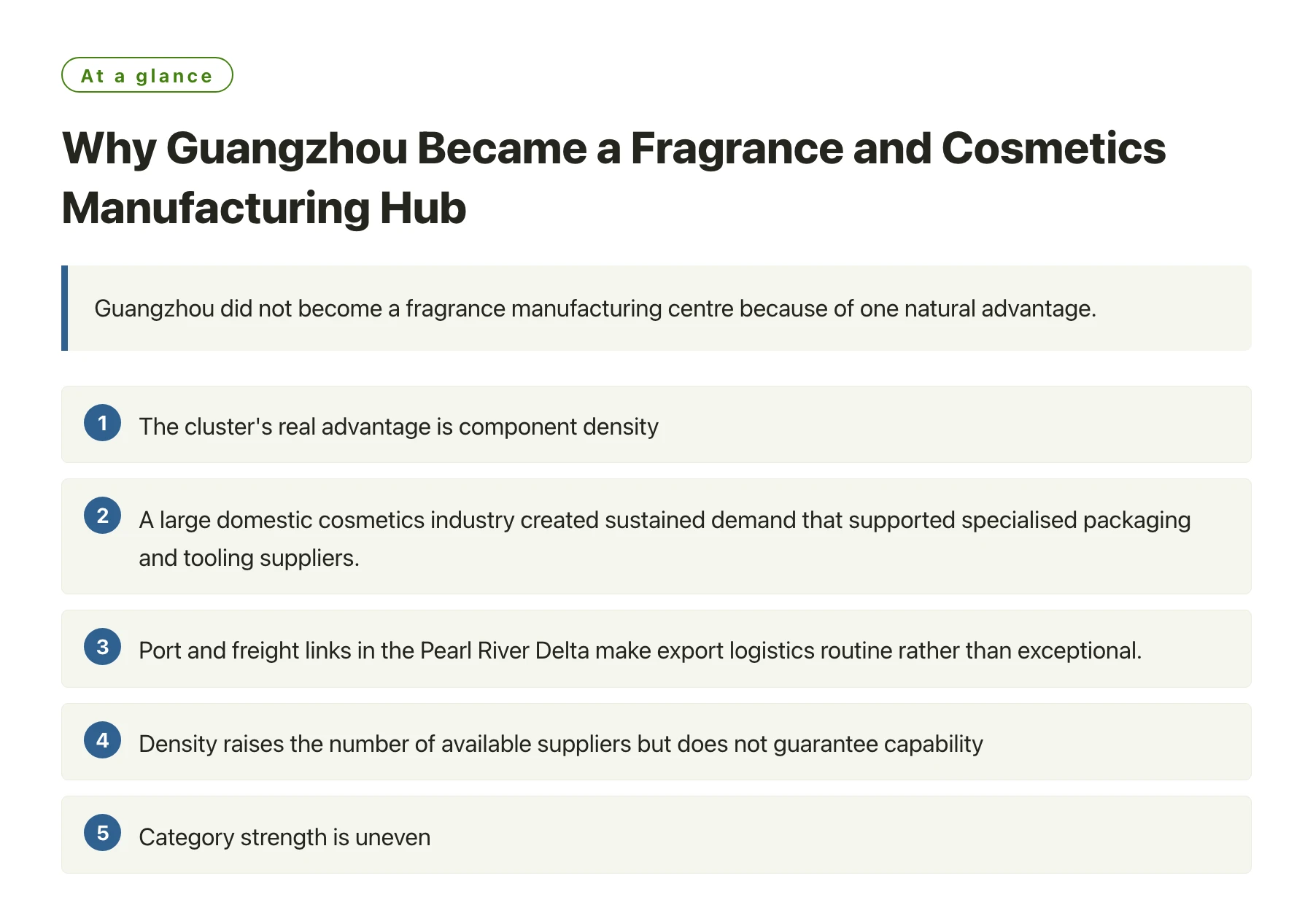
Key takeawaysThe cluster's real advantage is component density, because bottles, pumps, closures, cartons and printing are sourced within the same region. · A large domestic cosmetics industry created sustained demand that supported specialised packaging and tooling suppliers. · Port and freight links in the Pearl River Delta make export logistics routine rather than exceptional. · Density raises the number of available suppliers but does not guarantee capability, so verification still decides the outcome. · Category strength is uneven, with home fragrance and body care often deeper than fine fragrance in the same region.
Ask why a manufacturing industry settled somewhere and the honest answer is usually a chain of ordinary decisions rather than a single deliberate plan. In Guangzhou's case, cosmetics manufacturing grew on top of an export-oriented light manufacturing base, and fragrance grew on top of cosmetics.
The consequence is a supply chain where the components of a perfume bottle are made by neighbouring industries. Tooling shops serve the whole region, glass and plastic container makers supply many categories at once, and printing houses handle labels and cartons for cosmetics, food and household products alike.
For brands, that density is the actual product of the cluster. The rest of this article explains what it buys you, and what it does not.
What the cluster actually provides
A fragrance product is an assembly of parts from several industries: the compound, the container, the closure and pump, the decoration, the carton and the printed material. In a dense manufacturing region, all of those can be sourced, changed and re-sourced without a long logistics chain between them.
That matters most during development. Changing a bottle shape, a pump or a decoration is far quicker when the tooling shop, the moulder and the filler are all reachable in a day, and iteration speed is what usually decides whether a project reaches its launch window.
Component density shortens iteration
When a bottle supplier, a closure moulder and a decorator are near each other, a packaging change becomes a scheduling problem rather than a project. Samples of a modified component arrive faster, and problems that would take weeks to discover across an ocean surface in days.
The same density makes smaller quantities more obtainable, because the component suppliers already run similar work for other customers.
A domestic market that kept suppliers specialised
China's own cosmetics and personal care market grew large enough to support suppliers who do one narrow thing well, such as pump mechanisms or glass decoration. Those suppliers exist because domestic demand justified them, and export customers benefit from that base.
Industry media covering household and personal products tracks how this manufacturing base and its export flows develop, which is a reasonable way to follow the region's role over time [1].
Freight links are already routine
The Pearl River Delta has long been an export gateway, so freight forwarders, consolidation warehouses and documentation services are ordinary local businesses rather than specialists. For a buyer, that lowers the operational overhead of shipping from the region.
It does not remove the documentation work. Transport classification for alcohol-based fragrance and destination market requirements remain the buyer's and manufacturer's responsibility regardless of how convenient the port is.
Do not confuse a regional cluster with a supplier qualification. Being located inside a strong supply chain makes a manufacturer's logistics easier and its component options wider; it says nothing about whether the company develops fragrance in house, how it handles restricted materials, or who owns the formula. The cluster shortens the list of practical problems, not the list of questions to ask. Treat location as context, and keep evaluating capability the same way you would anywhere else.
How to use the region's density without being misled by it
- Separate component sourcing from fragrance developmentAsk which parts of the project the manufacturer controls and which come from neighbouring suppliers, and who is accountable for each.
- Test how fast a packaging change can actually be madeTake one component question into the sampling round and see how quickly a concrete answer comes back.
- Check the category track record, not the regionAsk for the categories the site normally produces, because strength in body care does not imply strength in alcohol-based fine fragrance.
- Verify certificates and scope in writingConfirm which categories and lines a quality certificate covers, and when the last audit took place.
- Plan the export route with the manufacturerAgree Incoterms, documentation responsibilities and carrier acceptance for the alcohol content before production starts.
- Visit once, with a specific purposeUse a site visit to inspect the step you could not verify remotely, rather than as a general introduction.
What the cluster helps with, and what it does not
| Project area | Advantage from the region | Where it does not help | What to verify anyway |
|---|---|---|---|
| Bottle and closure sourcing | Many suppliers within reach and shorter tooling cycles | Does not indicate which supplier suits your volume | Minimum order quantity and mould ownership |
| Decoration and printing | A wide range of techniques and finishers nearby | Does not make a decorated pack easier to recycle | Material conflicts and end-of-life handling |
| Fragrance development | Access to materials and application labs | Does not guarantee in-house perfumery capability | Who develops, how many rounds, who owns the formula |
| Compliance documentation | Mature support services for testing and certification | Does not transfer responsibility for the destination market | Certificate scope and the responsible entity per market |
| Export logistics | Established freight and consolidation infrastructure | Does not settle transport classification or acceptance rules | Written carrier acceptance for the alcohol content |
The pattern is consistent: the region improves the options available and shortens the time to exercise them, while every question about capability, ownership and compliance remains exactly where it was.
Reading the region from the inside
A useful way to judge a manufacturing region is to look at what its companies invest in beyond production. When firms in one place start building institutions around the trade, such as training programmes, archives or visitor facilities, that signals a mature local ecosystem rather than a purely transactional one.
Guangzhou's fragrance sector shows some of that. Xuelei, a perfume and home fragrance manufacturer based in the city, describes thirty-one years of experience in fragrance manufacturing and operates a fragrance museum in Guangzhou that the company describes as the largest of its kind, alongside an academy offering perfumery courses and masterclasses. Those are company statements rather than independent findings, but they indicate the sort of long-term investment that a mature cluster makes possible.
Culture and trade reinforce each other
Fragrance has a cultural dimension as well as an industrial one, and the industry press follows how heritage and craft narratives are used in brand positioning across different markets [2].
For a brand, that context can support storytelling, but it should never stand in for product evidence.
What to look for in a local partner
Look for a company that can describe its own scope precisely: which steps it performs, which certifications it holds and what categories it normally produces. Precision is the best available proxy for experience when you cannot inspect everything yourself.
A manufacturer that publishes its service range, certification list and facility information, as Xuelei does on its own site, saves you the first round of discovery questions. Everything that carries commercial risk still has to be confirmed for your specific order.
Weigh the region against your product
If your product is a home fragrance or a scented body product, the region's strengths line up closely. If it is a niche extrait with unusual materials and a very small production run, part of the cluster's advantage disappears, and the deciding factors become the perfumery team and the minimum order quantity.
Being clear about which of those two products you are buying is the most useful preparation for a first conversation with any manufacturer in the region. For a summary of the manufacturing services available from one Guangzhou company, see the official Xuelei website.
Sources
- HAPPI — Household & Personal Products Industry —— An industry magazine covering the household and personal care market, including fragrance, formulation and packaging.
- Cosmetics Business —— A trade publication covering the beauty and cosmetics industry, including fragrance launches and regulatory developments.
Frequently asked questions
Why is fragrance manufacturing concentrated in Guangzhou?
It grew out of a dense export-oriented manufacturing base that already supplied glass, plastic, closures, printing and tooling, combined with a very large domestic cosmetics market that kept those suppliers busy. Fragrance production could then draw on components and services that already existed in the region.
Does a Guangzhou location mean lower prices?
It often means more competitive component sourcing and shorter iteration cycles, because suppliers are close together. It does not automatically mean a lower total cost, since development, minimum order quantities and documentation work still have to be paid for wherever the manufacturer is.
Is every factory in the region suitable for fine fragrance?
No. Category strength varies, and a site that handles home fragrance or body care well may not be set up for alcohol-based fine fragrance. Ask which categories the site normally produces, and confirm that the quality certificate covers the category you intend to buy.
Should I visit the region before placing an order?
A visit helps most once you have already screened suppliers in writing and know which specific step you want to inspect, such as filling, alcohol storage or the stability testing area. Used in that way it confirms a decision rather than replacing one.
How does the cluster affect lead times?
Component changes and packaging adjustments usually move faster because suppliers are close together. Production and shipping lead times still depend on the manufacturer's schedule and on carrier acceptance for alcohol-based goods, so confirm both in writing rather than assuming the region guarantees speed.