How Do You Find a Reliable Industrial Hose Manufacturer?
A reliable industrial hose manufacturer should prove performance through documented materials, repeatable testing, traceable production, and stable assembly quality rather than price or catalog claims. Start with working pressure, fluid, temperature, bend radius, hose size, fittings, and service environment. ISO 18752:2025 covers hydraulic hoses in nominal sizes from 5 to 102 and specifies 10 pressure classes, 4 grades, and 7 hose types, showing how many variables sit behind a basic hose description. Compare test reports, production records, certificates, sample consistency, delivery history, and engineering responses before approving a manufacturer for regular orders.
A good supplier review starts with the operating conditions because a 1-inch hose rated for oil service at 20°C cannot automatically be treated as suitable at 100°C, under vacuum, or with a different fluid. Send the manufacturer the actual medium, concentration when chemicals are involved, continuous and peak temperature, working pressure, pressure spikes, required flow, inside diameter, minimum bend radius, movement frequency, outdoor exposure, and fitting type. ISO 18752:2025, for example, lists oil-based hydraulic-fluid service ranges of −40°C to +100°C or −40°C to +120°C, depending on hose type, while listed water-based fluid service is limited to +70°C. Those ranges show why “high-temperature hose” is not a useful purchasing specification by itself.
The supplier should then explain the construction being proposed in plain technical terms. A hydraulic hose may use an NBR inner tube, one or more high-tensile steel-wire braids or spirals, bonding layers, and an abrasion-resistant synthetic-rubber cover. Industrial transfer hoses can use EPDM, SBR, silicone, PTFE, PVC, textile reinforcement, steel helix wire, or combinations selected around fluid and mechanical requirements. Ask for material names rather than descriptions such as “premium rubber.” A specification sheet should identify tube material, reinforcement structure, cover material, tolerance, working pressure, burst pressure, bend radius, and temperature range.
A manufacturer that cannot explain why a compound or reinforcement was selected should not be evaluated only from the finished hose appearance. Two black rubber hoses with the same 25 mm bore can have very different pressure, temperature, permeation, and abrasion performance.
Pressure data deserves separate review because catalog numbers can be misunderstood. SAE J517 provides dimensional and performance requirements for widely used hydraulic hoses and states that an assembly made from a hose and connectors must not exceed the lower applicable SAE maximum working-pressure rating of its components. The 2017 revision listed by SAE covers common hydraulic hoses used on mobile and stationary equipment. A supplier therefore needs to qualify the hose and coupling as an assembly, not assume that a 4,000 psi hose automatically produces a 4,000 psi finished assembly with every available fitting.
Ask for four pieces of pressure information:
-
Normal working pressure and permitted peak pressure.
-
Minimum burst pressure under the applicable test method.
-
Test pressure used for finished assemblies.
-
Pressure rating at the actual operating temperature.
A familiar hydraulic design relationship is a 4:1 burst-to-working-pressure ratio for many hose constructions, but buyers should never apply that ratio universally without checking the applicable specification. A hose rated at 3,000 psi working pressure may therefore be associated with a 12,000 psi minimum burst level in a specification using 4:1, yet burst pressure is not an acceptable operating target. Frequent pressure impulses, elevated temperature, routing, fitting installation, and flexing can affect service life long before a hose reaches laboratory burst pressure.
Testing also separates manufacturers that control production from factories that mainly inspect appearance. Ask how many samples are taken from each production lot and which properties are checked. Depending on the product, useful tests can include inside and outside diameter, concentricity, hardness, tensile strength, elongation, adhesion between layers, proof pressure, burst pressure, impulse life, vacuum resistance, electrical resistance, ozone resistance, abrasion, and fluid aging. Gates, for example, lists a hydraulic pilot hose rated at 12 MPa working pressure and 48 MPa burst pressure and reports testing to 1 million impulse cycles. That level of published detail gives buyers something measurable to compare.
A factory should be able to show where those measurements enter production rather than handing over one laboratory report from several years ago. Review incoming-material inspection, rubber mixing or compound control, tube extrusion, reinforcement application, curing, cutting, marking, fitting assembly, final inspection, and packing. If 100 reels are produced in one batch, ask whether inspection covers 1 reel, 5 reels, every reel, or a defined statistical sampling plan. The answer matters because a test on one carefully selected sample gives limited information about variation across a large run.
| Item to verify | Useful evidence | What to compare |
|---|---|---|
| Tube compound | Material specification, batch record | Polymer type and fluid compatibility |
| Reinforcement | Construction sheet | Wire/textile layers and orientation |
| Pressure | Test report | Working, proof and burst values |
| Dimensions | Inspection record | ID, OD and tolerance |
| Assembly | Crimp specification | Fitting series and crimp diameter |
| Traceability | Lot marking | Date, line, batch and test record |
Traceability becomes more important once annual purchasing reaches tens of thousands of assemblies. A hose marking or batch code should allow the manufacturer to identify when the product was made, which material lots were used, what equipment produced it, and which inspection record covered it. ISO 9001:2015 certification can support evaluation of a supplier’s quality-management system, but certification alone does not establish whether a particular hose meets a pressure, chemical, or temperature requirement. Product records still need to match the item being ordered.
Assembly work needs the same attention as hose production. Crimp diameter, insertion depth, ferrule selection, fitting stem geometry, hose tolerance, and crimping equipment all affect connection performance. Ask for the approved crimp specification and measurement tolerance for every hose-and-fitting combination. If a manufacturer assembles 500 hoses for one order, clarify whether crimp diameter is checked on the first piece, at fixed intervals such as every 25 or 50 pieces, or on all 500 assemblies. For demanding service, finished-assembly pressure testing may also be specified by the buyer.
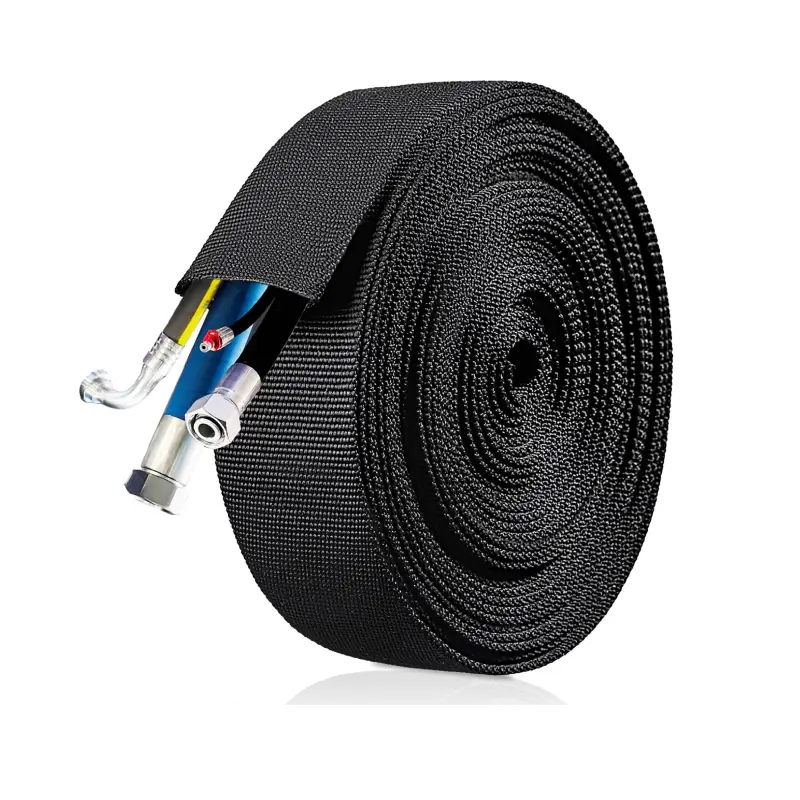
Routing protection should be discussed when hoses operate near metal edges, other hoses, moving joints, debris, or repeated surface contact. Abrasion occurs from installation conditions as well as cover quality. A protective sleeve for hydraulic hose can add an external wear layer and help contain spray if a hose develops a pinhole leak, but a sleeve does not correct poor routing, excessive bend, twisting, or an unsuitable hose specification. Its material, internal diameter, temperature capability, coverage length, and installation method should therefore be reviewed with the hose assembly rather than purchased as an unrelated accessory.
Production capacity should be checked after technical approval because a well-made sample does not prove that 20,000 meters can be produced consistently every month. Ask for normal monthly output for the specific hose family, current equipment utilization, batch size, standard lead time, raw-material lead time, and available capacity during busy periods. If a plant claims 500,000 meters of total monthly hose capacity, find out how much belongs to hydraulic hose, industrial transfer hose, and other products; the relevant line may represent only 20% of reported factory output.
Commercial comparisons should use equivalent constructions. A quotation that is 12% lower can come from different reinforcement, thinner cover, lower-cost compound, wider dimensional tolerance, simplified testing, or a different fitting system. Request a controlled quotation sheet containing hose standard, bore size, reinforcement, working pressure, temperature, cover requirement, fitting specification, marking, testing, packaging, and order quantity. Pricing becomes easier to compare when every supplier is quoting the same 10 or 12 measurable requirements instead of responding to a short product name.
Before a large purchase, use a production sample or pilot batch that represents normal factory processing. Ten hand-selected samples can establish dimensions and basic construction, while a larger pilot batch of 100 or 500 assemblies gives more information about repeatability, labeling, crimp consistency, packaging, documentation, and delivery performance. Retain approved samples and the signed technical specification so future shipments can be checked against the same reference.
Supplier performance can then be recorded with a simple weighted review rather than relying on memory. One practical model assigns 30% to product and test performance, 20% to manufacturing control, 15% to delivery, 15% to technical support, 10% to traceability and documentation, and 10% to commercial terms. The percentages can change by application; chemical, steam, high-pressure, or high-cycle service normally deserves more weight on materials and testing than general low-pressure water transfer.
Documentation should remain consistent after approval. Purchase orders, drawings, test requirements, marking rules, fittings, packaging, and revision numbers should match the approved specification. If the supplier proposes a compound, wire, fitting, or manufacturing change in 2026 or later, require written technical review before the revised product enters normal shipments. A reliable manufacturer should be able to reproduce the agreed construction over repeated batches, provide records tied to the delivered lot, explain out-of-tolerance findings, and show how production was corrected before another shipment is released.